VESTIGE
a digital product passport that proves what a luxury item is, without exposing what the brand can't afford to reveal
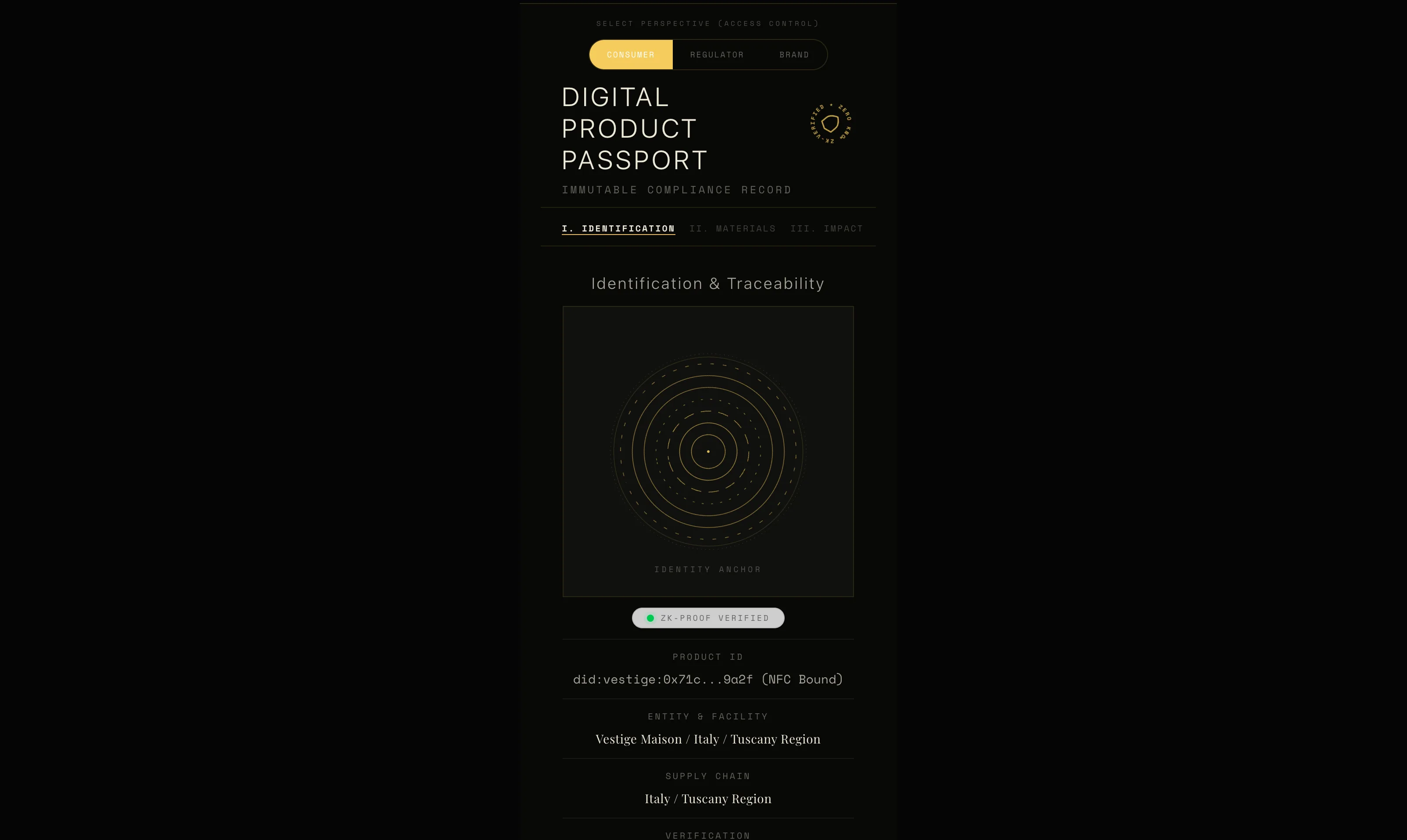
One commitment. Three audiences. Each sees only what it's allowed to, and can't reconstruct the rest.
WHAT
For luxury, the very facts that prove compliance are the ones a brand can't reveal.
WHY
Coming EU regulation will require a digital product passport. That forces a trade: disclose raw supply-chain data, or withhold it and fail compliance.
HOW
One cryptographic commitment generates role-differentiated zero-knowledge proofs, with an inference firewall so proofs cannot be combined.
Phase 1 · One commitment, three readings
A regulator sees a verdict, a brand partner a category, a consumer a story.
Supplier identity, cost and recipe stay hidden from all three: proven, not shown.
one commitment root
  ├── static identity
  ├── compliance state
  ├── dynamic ownership
  └── bio-material lineage
        │
        ├── policy circuit → regulator   compliance verdict
        ├── policy circuit → brand       approved-source category
        └── policy circuit → consumer    withheld
                                          ↑ inference firewall:
proofs cannot be combinedPhase 2 · Provenance that starts before manufacture
For mycelium leather and algae textile the significant phase is before cutting. Cultivation data enters a batch commitment every item inherits.
Phase 3 · The tap that changes state
A verified NFC tap (NTAG 424 DNA) becomes a presence receipt, and one atomic transaction carries the rest.
NFC tap (NTAG 424 DNA)
  → verified presence receipt
  → commitment updated
  → one atomic transaction:
       royalty routed · ownership transferred
lifecycle advanced · renderer steppedPROOF
PRESENTED TO INDUSTRY LEADS. The system was presented to leads at PwC, JPMorgan, and Tapestry. The cryptographic construction is covered in a filed provisional; this page describes the architecture, not the circuits.
- A filed provisional and a live mock-up, not a production deployment. The consumer passport at vestige.alilinlab.com demonstrates the renderer and the disclosure model; the full multi-circuit prover is specified, not yet shipped end to end.
It turns a regulatory burden into something a brand can use without surrendering what makes it a brand. The same instinct as a maker's mark, rebuilt in zero knowledge.